
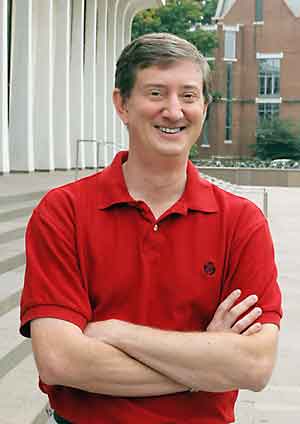
Ed Felten
Delivering a USENIX conference keynote address in Boston this week, FTC chief technologist Ed Felten urged fellow computer scientists to do as he has done and serve in government.
Felten said that “technologists should seek out government posts because it gives them the opportunity to affect public policy, which often affects their jobs,” reports Chris Kanaracus of IDG News.
Felten is on leave from Princeton, where he is a professor of computer science and director of the Center for Information Technology Policy.
:: :: ::

David Brooks
Princeton is on a bit of a winning streak when it comes to ACM’s annual Maurice Wilkes Award for contributions to computer architecture in the first 20 years of someone’s career.
This year it went to David M. Brooks, Gordon McKay Professor of Computer Science in the Harvard School of Engineering and Applied Sciences, who earned his Ph.D. in electrical engineering from Princeton in 2001.
Last year Kevin Skadron, who earned his Ph.D. in computer science from Princeton in 1999, won the same prize. He is a professor of computer science at the University of Virginia.
Margaret Martonosi, Hugh Trumbull Adams ’35 Professor of Computer Science, was Brooks’s thesis adviser and co-adviser to Skadron along with Doug Clark, professor of computer science.
Photo of David Brooks courtesy of Harvard.
:: :: ::

Congratulations to Princeton University’s 2012 Anita Borg winners: Willa Chen, Angela Dai, Amy Ousterhout, and Kanika Pasricha. They will visit Google in Mountain View, California, this summer for a networking retreat. Read more on the Google Anita Borg Memorial site.

The New York Times Magazine this week features a wireless “tooth tattoo” developed at Princeton that detects harmful bacteria.
The sliver-thin device — made of silk, graphene, and a tiny antenna — is applied to the tooth much like a child’s stick-on tattoo. It can detect bacteria associated with not just cavities but, perhaps more important, diseases elsewhere in the body. The researchers have already used it to identify bacteria associated with stomach ulcers and some cancers.
The Times included the tattoo in a piece featuring “32 Innovations That Will Change Your Tomorrow.” See the full piece here (the tooth tattoo is invention is #23).
The Times isn’t the only media outlet enraptured with the potential of the tooth tattoo.
Read more coverage in IEEE Spectrum, the Daily Mail, Gizmowatch, the Trenton Times, and the New York Daily News.
The research was reported March 27 in the journal Nature Communications.The paper’s Princeton authors included Michael McAlpine, assistant professor of mechanical and aerospace engineering, Naveen Verma, assistant professor of electrical engineering, graduate student Manu Mannoor, undergraduate Jefferson Clayton, and associate research scholar Amartya Sengupta at Princeton. Co-authors included Hu Tao, David Kaplan and Fiorenzo Omenetto of Tufts University and Rajesh Naik of the Air Force Research Laboratory.
Support for the research was provided by the American Asthma Foundation and the Air Force Office of Scientific Research. A full account of the research can be found here.

Princeton’s already enormously popular introductory computer science classes soon will be available on the new online learning platform Coursera. The first, on algorithms, created by Robert Sedgewick and jointly developed over the past decade by Sedgewick and his colleague Kevin Wayne, will be online late in the summer.
Sedgewick tells EQN that while it will be fabulous to have videos of his lectures online as part of Coursera, the courses already have a huge reach thanks to innovative course-related websites that Wayne and he have been developing for years.
More than half of all Princeton University undergraduates, regardless of major, take one of Sedgewick and Wayne’s computer science courses. Moreover their Princeton course websites already have a global reach: in 2011, they had 1.5 million unique visitors from across the world.
The algorithms course is based on a series of books by Sedgewick that have been bestsellers for decades (the most recent edition coauthored with Kevin Wayne). A second Sedgewick course, “Analytic Combinatorics,” based on the seminal textbook on the subject written by Philippe Flajolet and Sedgewick, will be offered in Spring 2013.
Sedgewick’s Algorithms textbooks have had wide influence on the teaching of computer science since the first edition was published in 1983. They are characterized by elegant implementations in real programming languages and demonstrate at the same time a wide range of real-world applications in graphics, animation and different scientific disciplines.
While non-Princeton students will benefit from free online access to these world-class computer science courses, Princeton students also will profit from the Coursera relationship, Sedgewick says.
“This will lead to more and better web content, improving what Princeton students already use,” he said. “It will provide extensive and powerful tools for their preceptors, who will then have more time for personal interaction with students.”
This fall Coursera also will be featuring a course on computer architecture by electrical engineering assistant professor David Wentzlaff.

Take note: the Princeton Laptop Orchestra, a k a PLOrk, is performing at Richardson Auditorium this Saturday.
How exactly does one go about making an orchestra out of laptops? “That’s a question we try to answer with every piece of ours,” Rebecca Fiebrink, the current co-director of PLOrk and an assistant professor of computer science, tells the Daily Princetonian.
“It might be analogous to a conventional instrument in that every time the student makes a physical gesture a sound is triggered, and the way that person makes the gesture changes the nature of the sound, such as key strokes and mouse clicks, and for a lot of pieces we use the motion sensor that’s built into the laptop.”
Get your tickets (only ten bucks!) here and read the full Prince piece here.
Photo by Lorene Lavora.

A new article on Politicocasts doubt on efforts to predict election results by monitoring social media.
The article features research by Mung Chiang, a professor of electrical engineering, and postdoctoral researchers Soumya Sen and Felix Ming Fai Wong. They recently published a paper analyzing the correlation between postings on Twitter (“tweets”) and box office revenues for popular movies.
And? After scrutinizing 15 million tweets on 34 different major movies they found that “even accounting for the hype and the approval level in Twitter may be insufficient to predict a movie’s rating from the general online population.”
The research has gotten attention elsewhere as well: Technology Review, ClickZ and The Register.
By the way, Chiang just won a big award from the Institute of Electrical and Electronics Engineers and last fall he taught a fascinating undergraduate course on the fundamentals behind the networked life.
Twitter Logo Map 09 courtesy thenextweb via Creative Commons.
 National Geographic recently featured “100 Scientific Discoveries That Changed the World.” Among them is a research breakthrough in regenerative medicine by Princeton engineering alumnus Cato Laurencin.
Laurencin’s work may drastically improve patients’ ability to recover from tears of the anterior cruciate ligament (ACL), one of the most common knee injuries.
Laurencin, who is director of the Institute for Regenerative Engineering at the University of Connecticut Health Center, graduated from Princeton in 1980 with a degree in chemical engineering.
Laurencin and other prominent alumni recently spoke with EQuad News magazine about what he sees as the major challenges for health.
 Last week J. Alex Halderman co-presented a paper explaining how he and a team of graduate students tested the Washington D.C. school board’s electronic absentee ballot system by hacking into it, flooding it with votes for the hard-drinking cartoon character known as Bender from the TV show Futurama and embedding the system with an audio clip of the University of Michigan fight song.
The hack, done at the invitation of the school board, “brought the city’s brief dalliance with internet voting to an ignominious halt,” The Washington Post reports.
Halderman, who earned his undergraduate degree and Ph.D. from Princeton in computer science, is now an assistant professor at the University of Michigan. The paper was presented in Bonaire at the Financial and Cryptography and Data Security Conference.
More detailed media coverage can be found on Gizmodo, Geekosystem, The Register, io9, The Escapist, and Techdirt. Halderman’s full academic paper can be found here.

You must be logged in to post a comment.